Overview
What this wiki is
A public research wiki about how AI is changing work: jobs, tasks, skills, teams, organizations, and how any of those changes can actually be measured. The lens is industrial–organizational (I-O) psychology — the science of people at work — applied to the questions organizations and workers face as AI moves from tool, to collaborator, to agent.
The central question:
How does AI change work, workers, jobs, organizations, and measurement — and what does I-O psychology help us understand, evaluate, and design better?
What’s inside
Two kinds of pages:
- Topics — synthesis pages, each built around one question: what the evidence says, where studies agree or contradict, and what remains unresolved.
- Sources — one page per paper or report: citation, summary, key claims, and limitations. Every claim on a topic page links back to the sources behind it.
How it runs
The wiki maintains itself on a daily loop: deterministic code discovers and fetches new literature, a language-model agent triages candidates and drafts synthesis, and a human reviews everything before it becomes part of the wiki. A report-only audit checks for contradictions and stale synthesis, and the wiki’s own open questions seed the next day’s search.
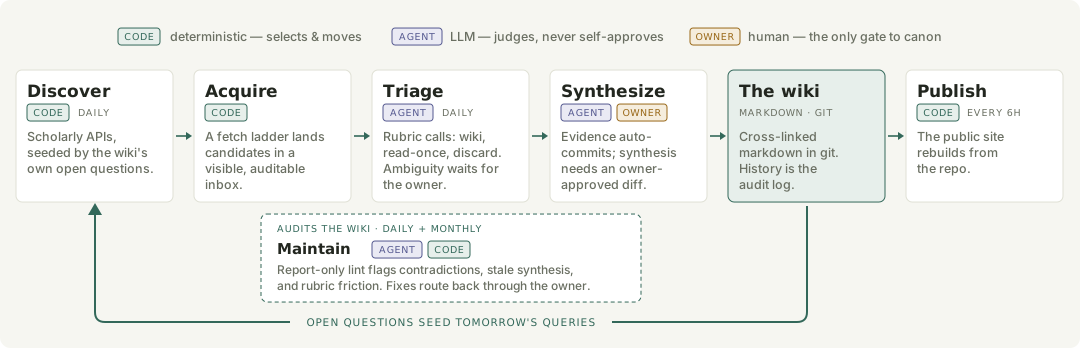
Scroll sideways on small screens, or click the diagram to open it full size.
Where to start
- topic-map — every topic, one line each
- open-questions — the cross-topic questions driving the research
- research-gaps — where the evidence base is still thin
- watchlist — candidate topics accumulating evidence before earning their own page
A note on method
Topic and source pages are drafted with the help of a large language model. Every topic page is reviewed by the maintainer before it becomes part of the wiki; source records are published as soon as they are written, and those not yet reviewed sit under sources/unreviewed/ with a visible notice until a reviewed synthesis integrates them. Even so, summaries can contain errors or lose nuance. Treat this wiki as a map of the literature, not a substitute for it — verify claims against the original sources before citing them.